
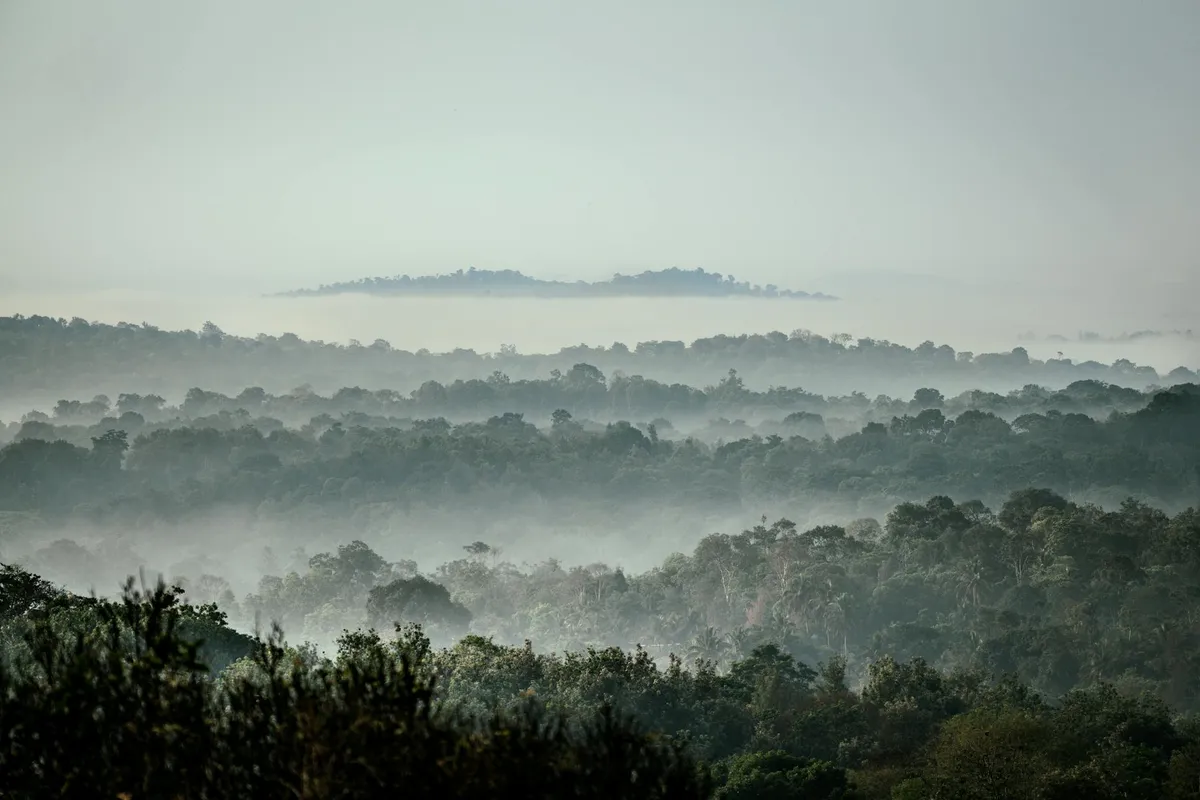
Madagascar's eastern rainforest is the dominant habitat type for the most diverse lemur fauna on the island. The forest runs along the eastern escarpment of Madagascar from approximately Andohahela National Park in the southeast to the Masoala Peninsula in the northeast, with substantial regional variation in elevation, rainfall, and forest structure. The lemur communities supported by the eastern rainforest include species that occur in no other habitat type and species ranges that map closely to specific structural features of the rainforest landscape.
This piece reviews how the structural features of the eastern rainforest determine lemur population dynamics — what species the habitat can support, at what densities, and what the relationships between forest structure and lemur ecology imply for the conservation work in the region.
The principal structural features of the eastern rainforest
The eastern rainforest runs along the escarpment that drops from the central highland plateau to the eastern coastal plain. The orographic rainfall produced by the trade winds rising over the escarpment supports forest cover that ranges from approximately one thousand five hundred to over four thousand millimeters of annual rainfall, with regional variation that produces distinct forest types within the broader rainforest belt.
The lowland eastern rainforest, occurring at elevations below approximately eight hundred meters, supports the most structurally complex forest on the island. Canopy heights regularly exceed thirty meters, with emergent trees reaching forty to fifty meters in undisturbed stands. The understory is correspondingly complex, with multiple structural layers and a high density of lianas, epiphytes, and structurally distinct microhabitats.
The mid-elevation rainforest, occurring at approximately eight hundred to one thousand five hundred meters, shows reduced canopy heights but increased epiphyte density and distinctive species composition. The mid-elevation forest supports lemur species that occur at lower densities or not at all in the lowland forest, and the elevation-mediated species turnover is one of the principal drivers of total lemur diversity in the eastern habitat.
The high-elevation rainforest, occurring above approximately one thousand five hundred meters, is structurally distinct again, with shorter canopy, denser ground cover, and species composition adapted to the cooler temperatures and higher cloud cover of the elevations. The high-elevation forest is also the most-fragmented contemporary forest type because of historical clearance for agriculture in the highlands.
How forest structure determines lemur species presence
The lemur species that occupy the eastern rainforest show distinct relationships with the structural features of the forest. The Indri (Indri indri) is principally a canopy species that requires intact canopy structure with continuous arboreal connectivity. The species occurs at densities that track forest structural integrity closely, with substantially reduced presence in degraded or fragmented forest.
The diademed sifaka (Propithecus diadema) shows similar canopy-structure dependence but with greater tolerance for disturbed forest than the indri. The species can persist in moderately degraded forest but shows reduced reproductive success and altered group structure in disturbed habitat. The data on the disturbance response are most extensively documented for the populations in the Andasibe-Mantadia area.
The bamboo lemurs (Hapalemur and Prolemur species) show strong dependence on bamboo presence, with species-specific dependence on particular bamboo genera. The greater bamboo lemur (Prolemur simus) is critically endangered partly because the species' bamboo dependence requires both the bamboo and the supporting forest structure that the bamboo grows within. The species' contemporary distribution is patchy and tracks bamboo availability tightly.
The eastern woolly lemurs (Avahi species), the eastern mouse lemurs (Microcebus species), and the eastern dwarf lemurs (Cheirogaleus species) show different structural dependencies, with the smaller-bodied species generally able to persist in more disturbed habitat than the larger species. The total lemur community at any given site reflects the interaction of habitat quality, elevation, and the specific structural features that the various species require.
How density relates to forest structure
Lemur densities in the eastern rainforest vary substantially across sites and across forest types. The factors that drive density variation include canopy structure, food resource availability, habitat connectivity, and the historical pressure from hunting and habitat use.
The well-protected sites in the eastern rainforest support lemur densities that are toward the upper end of what the published literature has documented for Madagascar's lemur fauna. The Andasibe-Mantadia area supports indri at densities that have been measured at approximately ten to fifteen individuals per square kilometer in the most-protected areas, with diademed sifaka densities in the same range.
The less-protected sites in the eastern rainforest support measurably lower densities, with the difference attributable principally to habitat degradation and to historical hunting pressure. The density differences are large enough that they substantially affect the conservation analysis of population viability across the species range.
The relationship between forest structure and lemur density is also non-linear. Small reductions in canopy continuity can produce disproportionately large reductions in indri density because the species' territorial structure depends on canopy connectivity. Similar non-linear relationships have been documented for several other eastern rainforest species, with implications for how conservation management responds to incremental habitat degradation.
What the contemporary rainforest looks like
The eastern rainforest has been substantially fragmented over the past several decades, with continuing forest loss across most of the eastern habitat band. The contemporary rainforest is a mosaic of relatively intact protected areas, partially degraded forest in less-protected areas, and increasing areas of secondary forest and agricultural land replacing what was previously primary forest.
The most-intact contemporary rainforest is concentrated in the larger protected areas — Andasibe-Mantadia, Ranomafana, Marojejy, Masoala, and several smaller reserves. These areas together represent a small fraction of the historical rainforest extent, but they support the most-stable lemur populations and the most-active research programs in the eastern habitat.
The connectivity between protected areas has been reduced substantially by the surrounding agricultural conversion, with implications for the long-term genetic viability of lemur populations. The conservation work in the region has increasingly focused on connectivity restoration through reforestation projects, community-based conservation in the surrounding areas, and the policy work that affects whether the protected area network can be expanded.
What the dynamics imply for conservation
The relationship between forest structure and lemur population dynamics implies that conservation work in the eastern rainforest cannot be reduced to forest-area protection alone. The structural integrity of the protected forest matters substantively for the lemur populations the protected forest can support, and the surrounding habitat matters for the long-term population connectivity that determines genetic viability.
The conservation interventions that have shown the strongest measured effect in the eastern rainforest combine protected area management with research-based monitoring, community engagement programs in surrounding areas, and the policy work that maintains the broader protected area network. The interventions that have produced measurable population stabilization are real, and the methodology that supports them is rigorous.
The contemporary trajectory of the eastern rainforest suggests that the species composition that persists over the coming decades will depend substantially on how the protected area network is managed and on whether the connectivity restoration work continues at the scale that the long-term population viability requires. The work is doable. The empirical foundation for it is in place. The continued effectiveness depends on the resources and the policy support that the work continues to receive.