
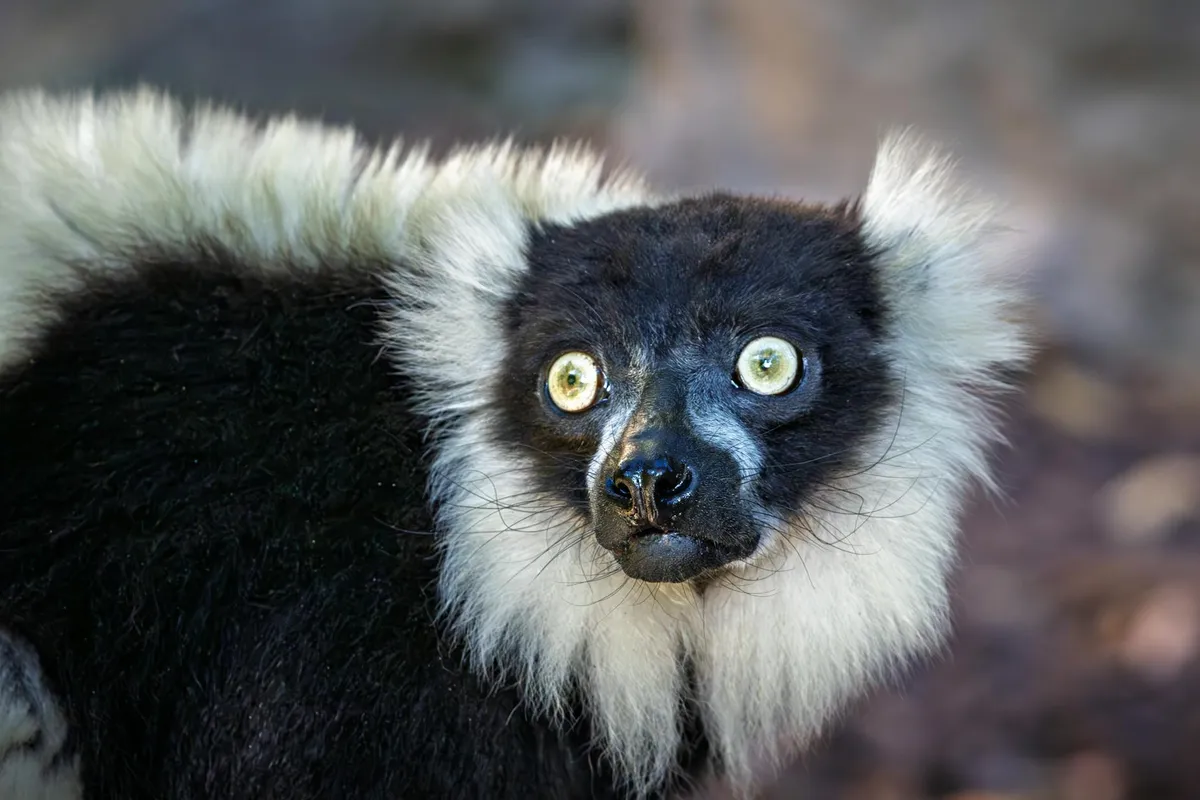
The Indri (Indri indri) is the largest extant lemur species and one of the most behaviorally distinctive primates on the island. The species occupies a relatively narrow band of Madagascar's eastern rainforest from approximately Andasibe-Mantadia in the central east to the rainforests around Maroantsetra in the northeast, with the densest contemporary populations in the protected areas around Andasibe and the Mantadia National Park.
The most-studied feature of Indri behavior is the species' vocal communication, particularly the long-distance call commonly described as the indri "song." The research on what this vocalization is, how it functions, and what variation it shows is significantly more developed than the typical natural-history coverage suggests. The aim of this piece is to summarize what the field research and the published literature have established, with attention to methodology and to the parts of the picture that remain genuinely uncertain.
What the song actually is, structurally
The indri song is a coordinated multi-individual vocalization produced primarily by adult and subadult group members, with structural features that have been documented across multiple field studies. The vocalization typically lasts between approximately forty seconds and three minutes. It includes phrases that have been classified into discrete acoustic categories — the "roar" introduction, the "long-note" descending phrases, and the more variable phrase structures that follow.
The classification scheme that has been most influential in the literature distinguishes the song's components by spectral structure and by the social role that different group members appear to play in producing them. The introduction is generally produced by the dominant adult pair, with group members joining the long-note phrases in sequence. The phrase structure shows individual variation that has been used in some studies to identify specific groups acoustically.
The acoustic complexity of the indri song is unusual for non-human primates. The frequency range, the structural organization, and the multi-individual coordination together represent a vocalization that has invited comparison to gibbon song and to certain bird vocalizations rather than to most primate calls. The methodological work on whether the song meets specific definitions of "song" used in animal-communication research has produced a literature of its own.
What the song appears to function for
The function of the indri song has been investigated through both correlational fieldwork and experimental playback studies. The most-supported function is territorial — the song appears to communicate territory occupancy and identity to neighboring groups, with playback studies showing differential response patterns to recordings of neighboring versus unfamiliar groups.
The territorial-communication hypothesis is strongly supported but is probably not complete. Several research programs have documented song production patterns that suggest secondary functions including group cohesion, mate guarding, and possibly something approaching cultural transmission of group-specific phrase structures. The literature is more developed on the territorial function than on these secondary hypotheses.
The timing of song production has been documented with some precision. Indri groups produce the song most often in the morning hours, with peak production typically between approximately 07:00 and 11:00 in the rainy season and somewhat later in the dry season. The seasonal variation in production frequency tracks several variables including reproductive cycle and inter-group competition intensity, with the precise relationships still being investigated.
What the field methodology actually looks like
The research that produces these conclusions involves sustained direct observation of habituated groups, acoustic recording with calibrated equipment, and increasingly the use of automated acoustic monitoring stations that can record over extended periods without human presence. The methodology has developed substantially over the past two decades.
The habituation work that allows direct observation is itself a substantial undertaking. Habituating a wild lemur group to human observers without altering the behavior of interest requires months of careful presence work, with explicit protocols for distance maintenance, observer rotation, and behavioral measurement to confirm that the group is responding normally rather than showing observer-influenced behavior. The methodological literature on this is extensive and worth engaging with for anyone trying to interpret the field-research conclusions.
The acoustic recording methodology has been transformed by the availability of compact, weatherproof recording units that can be deployed in the field for extended periods. The resulting data sets are large enough that automated acoustic analysis has become an active methodological area. The combination of automated detection, manual verification, and statistical analysis of the resulting acoustic record has produced findings that earlier methodologies could not have reached.
What remains genuinely uncertain
Several aspects of indri vocal behavior remain genuinely uncertain in the literature. The precise mechanisms of phrase coordination across group members have been documented descriptively but have not been fully resolved at the level of vocal-motor control. The cultural transmission hypothesis — that specific phrase structures propagate within groups in ways analogous to bird song traditions — has supportive evidence but has not been definitively established.
The conservation implications of the song production are also incompletely understood. The species is critically endangered, and the relationship between song production patterns and population health is an active area of research. Reduced song production has been documented in some populations under habitat stress, but the causal relationships involved are still being investigated.
Why this matters for the conservation picture
The indri occupies a relatively narrow habitat band, the species does not survive well in captivity, and the population trend across the species range is downward. The research on indri behavior is therefore conservation-relevant in ways that go beyond the natural-history interest. Understanding the species' vocal behavior, social structure, and habitat requirements informs the conservation interventions that have any prospect of stabilizing the population.
The protected areas at Andasibe-Mantadia and at the Anjozorobe-Angavo corridor provide the most secure contemporary habitat for the species. The conservation work in these areas has produced measurable population stability over recent decades, and the continued field research provides the empirical foundation for the management decisions that determine whether the stability persists.
The species will probably persist over the next several decades if the protected-area infrastructure remains functional and if the surrounding habitat fragmentation does not accelerate. The research that supports the management decisions is real, the methodology is rigorous, and the conservation picture is sober rather than catastrophic — but only if the protected-area infrastructure continues to receive the resources it requires to function.